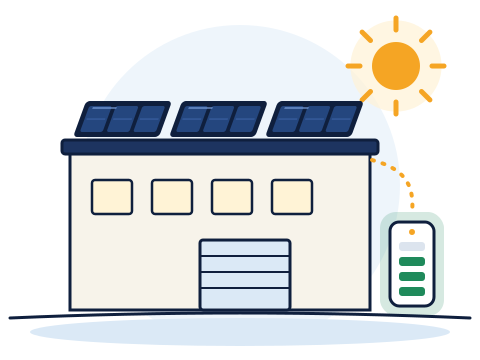
Quick answer: most Perth cafés and restaurants suit 15–50 kW of solar. Daytime trading uses most of the solar on site, which gives the fastest payback. A battery helps if you trade into the evening.
Your estimate
- Suggested system size
- –
- Typical installed cost
- –
- Estimated yearly savings
- –
- Payback
- –
- Net savings after 5 years
- –
- Net savings after 10 years
- –
Estimates only, using today’s power prices. Business rates and costs last checked 23 October 2026. Systems over 100 kW use a different rebate scheme, so quotes will vary more.
Why solar works for this kind of business
- Refrigeration and cool rooms run 24/7, giving a steady base load for solar to cover.
- Breakfast and lunch trade lines up with peak solar hours.
- Air-conditioning use peaks on hot afternoons, when panels produce the most.
- Lower running costs protect margins when food prices rise.
Where the power goes
In most cafés and restaurants the biggest users are refrigeration and cool rooms, cooking equipment (especially electric ovens and induction), dishwashers and hot water, and air-conditioning. Ask for your interval data from your retailer: it shows how much you use between 9am and 3pm, which is the share solar can cover directly.
Typical system sizes
| Business | Typical solar | Battery? |
|---|---|---|
| Small café | 10–20 kW | Rarely needed |
| Busy café or bakery | 20–40 kW | Sometimes, for early starts |
| Restaurant open for dinner | 30–60 kW | Often worth it for evening trade |
Systems up to 100 kW get the small-scale (STC) discount up front. Larger systems earn large-scale certificates over time instead. Typical installed cost is roughly $28,500–$39,000 for 30 kW in Perth, checked 23 October 2026.
What to ask installers
- How will the system be sized against my interval data, not just my bill?
- Can I keep trading during installation? Can work be done outside opening hours?
- Will a battery cover evening trade, and what is the payback with and without it?
- Do I need Western Power approval or an export limit?
- Who owns the system if I lease the premises?
How it works
-
1
Check your rebate
Use the calculator to see the federal and WA battery rebates and what a system could save you.
-
2
Tell us about your home
Answer a few quick questions: what you want, your roof, your bill and when you want it done.
-
3
Get matched with up to 3 installers
We send your request to no more than 3 vetted, accredited installers who cover your suburb.
-
4
Compare quotes and choose
Installers contact you with quotes. Compare them side by side. No cost and no obligation.
-
1
Tell us about your site
Your business type, power bill, roof space and how much power you use during the day.
-
2
Get matched with up to 3 commercial installers
Only installers who do commercial work, cover your area and hold the right accreditation.
-
3
Site assessment and tailored quotes
Installers check your roof, switchboard and usage data, then quote a system sized for your business.
-
4
Compare and choose
Compare price, payback and warranties. You decide, with no cost or obligation.
Common questions
Will solar cover my cool room overnight?
Not directly. Solar only produces during the day. A battery can carry some overnight load, but for most hospitality businesses the best value is covering daytime use first.
We rent our premises. Can we still get solar?
Yes, with the building owner’s written permission. Some leases share the cost or include the system when you move out.
How long is the payback?
Businesses that use most of their power during the day often see payback in about three to five years. Try the calculator with your own bill.
Estimates use typical Perth solar output (about 1,500 kWh per kW per year) and business power prices set in our calculator, checked 23 October 2026. Sources: Clean Energy Regulator (small-scale and large-scale renewable energy schemes). General information only, not financial advice.