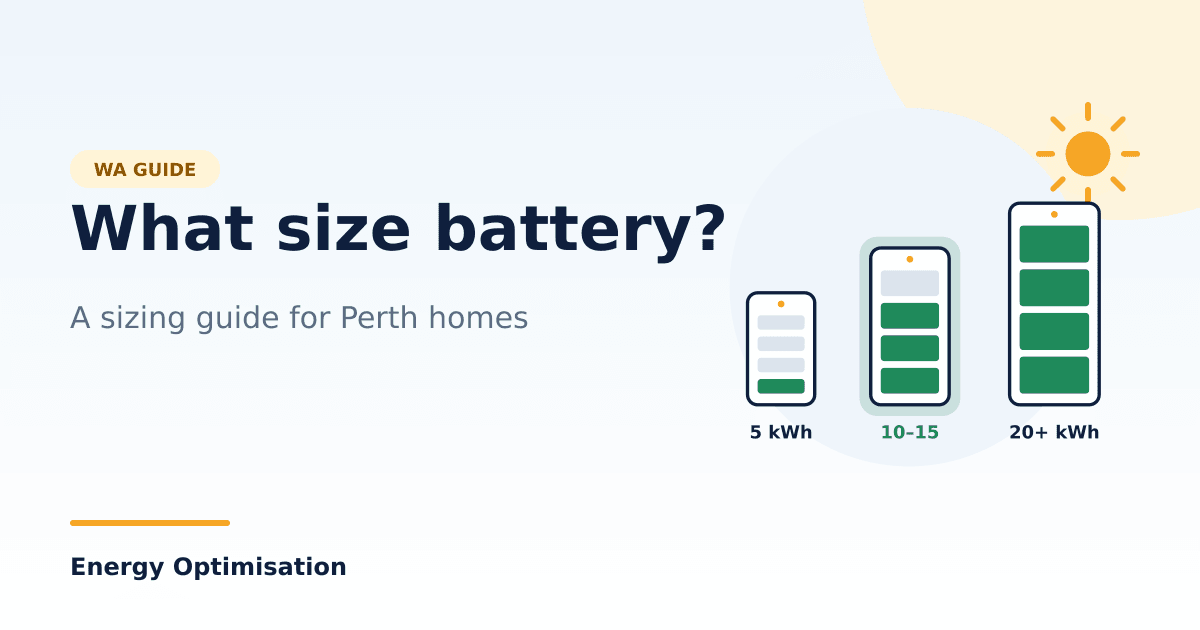
Most Perth homes with solar suit a battery of about 10–15 kWh. Too small and you’ll still buy power every evening; too big and the battery never fills, and since May 2026 the federal rebate shrinks above 14 kWh. Here’s how to work out the right size for your house.
Step 1: Find your evening use
A battery’s job is to cover the power you use after the sun goes down and before it comes up. Look at your Synergy or Horizon Power bill (or app) for your average daily use. For a typical family home, roughly half of that is used between late afternoon and morning: cooking, air con, hot water timers, TVs and the fridge running overnight.
So if you use 20 kWh a day, your evening and overnight use is probably around 10 kWh. That’s the number a battery should aim to cover.
Step 2: Check your solar can fill it
A battery only helps if your panels make enough spare power during the day to charge it. In Perth, each kW of solar produces roughly 4 to 5 kWh a day on average, more in summer and less in winter. A 6.6 kW system makes around 26–30 kWh on an average day. After your daytime use, that usually leaves enough to fill a 10–13 kWh battery for much of the year.
If you have an older, smaller system (say 3 kW), a large battery will often sit half-empty. Adding or upgrading panels at the same time can make more sense.
Step 3: Think about the rebates
- The WA rebate reaches its maximum at 10 kWh. Going bigger doesn’t increase it.
- The federal rebate pays the full rate on the first 14 kWh, 60% of it from 14 to 28 kWh, and 15% beyond that.
That’s why 10–14 kWh is often the sweet spot for value. Bigger batteries still make sense for homes with high evening use, electric cars, or a strong need for blackout backup.
Rough guide by household
| Household | Typical daily use | Battery to consider |
|---|---|---|
| 1–2 people, gas cooking | 8–14 kWh | 5–10 kWh |
| Family of 3–4 | 15–25 kWh | 10–15 kWh |
| Large family, pool or ducted air con | 25–40 kWh | 15–20 kWh, plus more solar |
| Home with an EV charging at night | Add 6–12 kWh per day of driving | Size for the house first; charge the car from solar where you can |
Usable vs total capacity
Batteries are sold with a total and a usable capacity. Rebates, and your savings, are based on usable capacity, so compare that figure across quotes. A “13.5 kWh” battery might be 13.5 kWh usable, while another brand’s “15 kWh” model might be closer to 13.
Try your own numbers
Our battery rebate calculator shows how the rebates and rough savings change as you move between sizes. A good installer will also look at your actual usage data before recommending a size. Be wary of anyone pushing the biggest battery without asking about your bills.