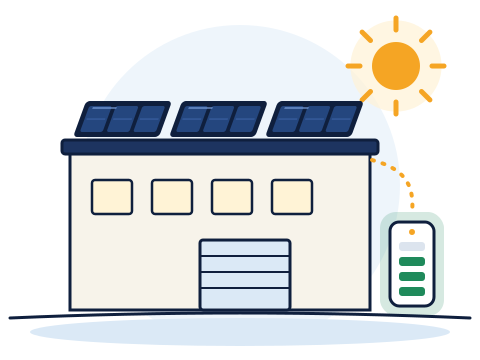
Quick answer: warehouses and workshops typically suit 30–100 kW, and larger sites go well beyond. Daytime machinery, lighting and compressors use most of the solar on site. Check the roof condition before installing.
Your estimate
- Suggested system size
- –
- Typical installed cost
- –
- Estimated yearly savings
- –
- Payback
- –
- Net savings after 5 years
- –
- Net savings after 10 years
- –
Estimates only, using today’s power prices. Business rates and costs last checked 23 October 2026. Systems over 100 kW use a different rebate scheme, so quotes will vary more.
Why solar works for this kind of business
- Large, flat or low-pitch roofs fit plenty of panels.
- Machinery, compressors and lighting run during working hours.
- High daytime use means most solar is used on site, not exported.
- Solar can reduce demand charges on some business tariffs.
Where the power goes
Common big users are compressors, motors and machinery, lighting, refrigeration, ventilation and EV or forklift charging. If you pay demand charges, ask installers to model how solar and a battery affect them, not just your energy use.
Typical system sizes
| Business | Typical solar | Battery? |
|---|---|---|
| Small workshop | 15–30 kW | Rarely |
| Warehouse or light industrial | 30–100 kW | Sometimes, for demand charges |
| Large factory | 100 kW+ | Case by case |
Systems up to 100 kW get the small-scale (STC) discount up front. Larger systems earn large-scale certificates over time instead. Typical installed cost is roughly $28,500–$39,000 for 30 kW in Perth, checked 23 October 2026.
What to ask installers
- What condition is the roof in, and should it be replaced before panels go on?
- Is the roof sheeting suitable for mounting, and does it contain asbestos?
- Will Western Power need a network study or set an export limit?
- How does solar affect my demand charges?
- Over 100 kW: how will large-scale certificates work for me?
How it works
-
1
Check your rebate
Use the calculator to see the federal and WA battery rebates and what a system could save you.
-
2
Tell us about your home
Answer a few quick questions: what you want, your roof, your bill and when you want it done.
-
3
Get matched with up to 3 installers
We send your request to no more than 3 vetted, accredited installers who cover your suburb.
-
4
Compare quotes and choose
Installers contact you with quotes. Compare them side by side. No cost and no obligation.
-
1
Tell us about your site
Your business type, power bill, roof space and how much power you use during the day.
-
2
Get matched with up to 3 commercial installers
Only installers who do commercial work, cover your area and hold the right accreditation.
-
3
Site assessment and tailored quotes
Installers check your roof, switchboard and usage data, then quote a system sized for your business.
-
4
Compare and choose
Compare price, payback and warranties. You decide, with no cost or obligation.
Common questions
Our roof is old. Should we wait?
If the roof needs replacing within about 10 years, do it first. Removing and refitting panels later is costly.
What about systems over 100 kW?
Larger systems don’t get the upfront STC discount. They earn large-scale generation certificates (LGCs) based on output. Approvals also take longer.
Can we add EV or forklift charging?
Yes. Charging during the day from solar is one of the cheapest ways to run electric vehicles and forklifts.
Estimates use typical Perth solar output (about 1,500 kWh per kW per year) and business power prices set in our calculator, checked 23 October 2026. Sources: Clean Energy Regulator (small-scale and large-scale renewable energy schemes). General information only, not financial advice.