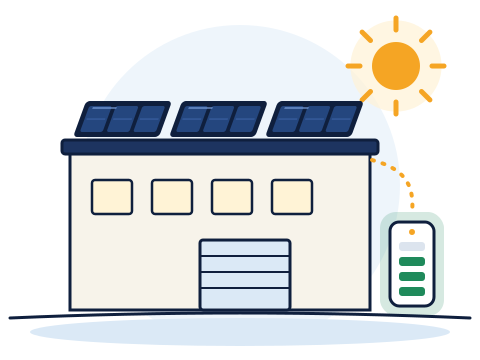
Quick answer: most clinics suit 10–40 kW of solar. Daytime opening hours use most of the solar on site. Consider a battery if keeping vaccine fridges or critical equipment running during outages matters.
Your estimate
- Suggested system size
- –
- Typical installed cost
- –
- Estimated yearly savings
- –
- Payback
- –
- Net savings after 5 years
- –
- Net savings after 10 years
- –
Estimates only, using today’s power prices. Business rates and costs last checked 23 October 2026. Systems over 100 kW use a different rebate scheme, so quotes will vary more.
Why solar works for this kind of business
- Opening hours match peak solar hours.
- Air-conditioning for patient comfort runs on hot afternoons.
- Sterilisers, imaging and IT draw steady daytime power.
- A battery can back up vaccine fridges and critical circuits.
Where the power goes
Typical users are air-conditioning, sterilisers and autoclaves, X-ray and imaging equipment, computers and servers, lighting, and medicine or vaccine fridges. Ask installers which circuits a battery could back up, and how quickly it switches over in an outage.
Typical system sizes
| Business | Typical solar | Battery? |
|---|---|---|
| Small practice | 10–15 kW | Sometimes, for backup |
| Multi-room clinic | 15–30 kW | Often, for critical circuits |
| Medical centre | 30–60 kW | Case by case |
Systems up to 100 kW get the small-scale (STC) discount up front. Larger systems earn large-scale certificates over time instead. Typical installed cost is roughly $28,500–$39,000 for 30 kW in Perth, checked 23 October 2026.
What to ask installers
- Which circuits can a battery back up, and how fast does it switch over?
- Will installation disrupt patients? Can it be done after hours?
- Will imaging or sensitive equipment be affected?
- Do we need Western Power approval or an export limit?
- If we lease, what does the building owner need to sign?
How it works
-
1
Check your rebate
Use the calculator to see the federal and WA battery rebates and what a system could save you.
-
2
Tell us about your home
Answer a few quick questions: what you want, your roof, your bill and when you want it done.
-
3
Get matched with up to 3 installers
We send your request to no more than 3 vetted, accredited installers who cover your suburb.
-
4
Compare quotes and choose
Installers contact you with quotes. Compare them side by side. No cost and no obligation.
-
1
Tell us about your site
Your business type, power bill, roof space and how much power you use during the day.
-
2
Get matched with up to 3 commercial installers
Only installers who do commercial work, cover your area and hold the right accreditation.
-
3
Site assessment and tailored quotes
Installers check your roof, switchboard and usage data, then quote a system sized for your business.
-
4
Compare and choose
Compare price, payback and warranties. You decide, with no cost or obligation.
Common questions
Can a battery keep our vaccine fridge running in a blackout?
Yes, if the battery is set up with backup on that circuit. Confirm the backup time and switch-over with the installer.
Will solar interfere with medical equipment?
A properly installed system shouldn’t. Mention any sensitive equipment when you ask for quotes.
Is solar tax deductible for a practice?
Solar is usually treated as a business asset that can be depreciated. Check with your accountant.
Estimates use typical Perth solar output (about 1,500 kWh per kW per year) and business power prices set in our calculator, checked 23 October 2026. Sources: Clean Energy Regulator (small-scale and large-scale renewable energy schemes). General information only, not financial advice.